Free Information
About Inflammatory
Bowel Disease in Cats
|
|
All About Inflammatory Bowel Disease in Cats
Feline Inflammatory Bowel Disease
By Margaret Muns, DVM
In cats, inflammatory bowel disease (IBD) is the most common cause of
chronic vomiting and diarrhea. The term actually refers to a group of
diseases that are characterized by the invasion of inflammatory cells into the
cat's intestinal wall.
Symptoms of IBD
One or many of the following symptoms can be found in a cat with
inflammatory bowel disease (IBD):
Vomiting
Diarrhea
Weight loss
Normal/increased appetite
Stomach rumbling
Belching
Black, tarry stools
Flatulence (from digested blood) Halitosis
Increased thirst
Abdominal pain
Weight loss
In severe cases, weight loss can be extreme. Vomiting cats will seldom
produce food in a cat's vomit. Instead, the vomit usually consists of
bile-stained mucus. The presence of hair or partially digested food in the
vomit indicates that the disease also involves the cat's stomach.
The most common form of inflammatory bowel disease in cats is the
presence of lymphocytes and plasma cells, which produce a diagnosis of
lymphocytic- plasmacytic enteritis (LPE).
Causes of LPE
This disease can develop in one of two ways. The inflammatory cells can
enter the intestinal wall in response to an injury or infection. Or, parasites,
food intolerance, bacteria, fungi, or cancer can cause activation of the
immune system and subsequent inflammation.
Cats that are affected with LPE may have a defective intestinal wall barrier.
This defect allows normal intestinal bacteria to leak into the deeper layers
of the intestinal wall, and the body mounts an immune response to remove
them. Subsequent inflammation damages the gut wall even further, allowing
more bacteria to enter the deeper tissues.
History and Clinical Signs
The most consistent clinical signs associated with feline
lymphocytic-plasmacytic enteritis are those consistent with a small-bowel
diarrhea syndrome.
LPE can occur in cats of any age, but most commonly appears in older
cats. LPE can affect any area of the intestinal tract, and can also be very
localized. Consequently, the symptoms of an affected cat are quite variable.
For example, clinical signs in some cats can appear suddenly, while in
others, the signs can be more subtle and intermittent. Many cats experience
exacerbation of symptoms only during times of stress, while others
experience constant problems.
Vomiting may be the only symptom of LPE. Often, cats with chronic
vomiting are misdiagnosed and treated symptomatically for stomach or
pancreatic disease, when the disease is actually located in the small
intestine.
Diagnosis and Treatment
Appropriate tests must be chosen by your veterinarian to rule out infectious
disease, parasites, obstructions and cancer. Metabolic disease (especially,
hyperthyroidism), concurrent large bowel disease, and pancreatic
insufficiency must be eliminated, since each can closely mimic the symptoms
of LPE. It is also important that your cat is screened for the viral
infections
feline leukemia and feline immunodeficiency because both diseases can be
associated with IBD.
In severe cases of LPE, cats may have one or more abnormal test results
that indicate advanced intestinal wall damage. In these cases, protein leaks
into the intestinal tract and subsequently, cats can have abnormally low
serum protein levels.
Definitive diagnosis of feline LPE can only be made by examining biopsy
samples from the intestinal tract. Lymphocytic-plasmacytic enteritis lesions
can be very localized, leaving the surface of the intestinal wall normal. If
only grossly abnormal tissues are sampled, the diagnosis may be missed.
The pathologist will usually report cases of LPE as mild, moderate, or
severe. A diagnosis of mild lymphocytic-plasmacytic enteritis may just
indicate a reaction to an underlying parasitic or infectious disease, and the
underlying causes should be addressed. A diagnosis of moderate to severe
LPE tells the veterinarian that more aggressive therapy should be
considered.
Dietary Therapy
Dietary therapy for feline LPE may or may not help, but it is certainly worth
trying. Inflammatory response can be triggered by an abnormal immune
reaction to normal intestinal components. Therefore, it may be possible that
one or more ingredients in the cat's food may be one of the underlying
causes.
Even if dietary therapy alone doesn't resolve the cat's symptoms, it can
allow other treatments to be more effective. Occasionally, a cat can be
completely weaned off oral medication and maintained on dietary therapy
alone. One possible explanation for the efficacy of dietary therapy is that it
helps the intestinal tract to compensate better, despite ongoing inflammation.
Effective dietary therapy for feline LPE involves feeding the cat a diet that
is
unlikely to trigger an immune response within the intestinal tract. To
accomplish this, the cat must be fed a home-cooked elimination diet
composed of a protein and carbohydrate source. Commercial
hypoallergenic diets are not effective.
A careful dietary history should be obtained to find out which ingredients
the cat has eaten over its lifetime. Once known, a food can be formulated
consisting of a protein and carbohydrate source that the cat has never had.
During the dietary trial (ideally five to six weeks), nothing but that special
diet and water must be ingested by the cat, including treats, chewable
vitamins, or chewable medications. If the cat has improved by the time the
trial period ends, you can try switching to a commercial diet based on the
protein source used.
Some cases of feline LPE may benefit from additional dietary manipulation.
Adding extra fiber into the diet may help cats with large bowel involvement.
Although the increased fiber doesn't have any anti-inflammatory effect, it
can help to improve fluid balance inside the intestine and relieve diarrhea.
Severe cases may benefit from additional vitamin and mineral
supplementation.
A severely inflamed small intestine cannot absorb vitamins and minerals
efficiently, which can result in a deficiency. Vitamin deficiencies can
adversely affect the course of the disease. For example, folic acid and
cobalamin may contribute to the small intestine's ability to repair itself.
Therefore, supplementation of these important vitamins should be
considered.
Drug Therapy
There is no set treatment regimen for every case of
lymphocytic-plasmacytic enteritis in the cat. The appropriate choice of
immune-suppressing drugs for treating feline LPE is up to your veterinarian.
Treatment must be tailored to each cat's needs.
Prednisone (a potent corticosteroid) is usually the initial drug of choice for
treating feline LPE. As a class, the corticosteroids are powerful immune
suppressive and anti-inflammatory agents. In addition, treatment with
corticosteroids may improve the fluid and electrolyte balance within the
intestine. This can have a significant role in decreasing diarrhea.
If prednisone alone is given, then improvement should be noted within the
first one to two weeks of therapy.Most cats with lymphocytic-plasmacytic
enteritis will require life-long prednisone therapy to avoid a relapse.
In severe cases of LPE, azathioprine can be useful as a very potent
immunosuppressive drug. Adding this drug to the treatment should be
considered in cats that are not responsive to prednisone alone. Also,
azathioprine can be used in cats that just cannot tolerate the adverse effects
of prednisone. However, cat owners must wait three to four weeks before
azathioprine will take effect.
Several other drugs can be tried for treating feline LPE. There is evidence
that metronidazole may have a direct immune suppressing effect.
Cyclophosphamide is a chemotherapy drug that also has potent immune
suppressing qualities. Again, it is important that your veterinarian choose
the
appropriate treatment for your cat.
Prognosis
Most cases of feline lymphocytic-plasmacytic enteritis cannot be cured,
although the disease is not usually life threatening. With aggressive therapy,
many cases can be adequately controlled.

Hairballs Can Jeopardize Your Cat's Health
By: Jane R. Bicks, D.V.M.
Cats spend up to 1/3 of their waking hours self-grooming. The tiny barbs
on a cat's tongue pull loose hair from it's coat and those hairs are
swallowed. Because hair is very difficult to digest, it compacts with
undigested food in the intestines.
The accumulation becomes a source of irritation if it is not eliminated in the
litter box or coughed up. The result is messy fur-like, cigar-shaped forms on
the floor or furniture. Some surgically removed hairballs are almost 3 inches
in diameter.
Although you may not see hairballs, there may be a significant accumulation
in your cat's stomach and intestines!
Signs of hairball problems:
Fur-like, cigar-shaped clumps of fur on floor or furniture.
Dry, hacking cough.
Vomiting after meals.
Preoccupation with eating plants or grass.
Hair entwined with the feces.
Dry dull coat and/or excessive shedding.
Poor appetite and/or weight loss.
Constipation or diarrhea.
Common Treatments:
Single focus products do not address a cat's entire system.
Mineral oil or petroleum lubricants are petrochemical products
Large amount of fiber can decrease intestinal absorption of nutrients
and may result in malnourished animal
Enemas for constipation requires tranquilization and can be
dangerous.
What Really Does Work?
A much better alternative for hairballs is HealthyPetNet's Purr-fectly
Natural, .... Gourmet Cat Treats.
Contains highly digestible animal proteins which nourish and
strengthen hair.
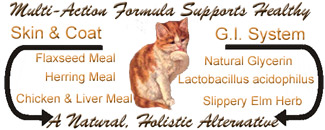
Contains essential fats from various sources including flaxseed meal,
which provides oils necessary for healthy skin and coat.
Improves coat health so less hair is swallowed during grooming.
Contains Lactobacillus acidophilus, a friendly bacteria that provides
nourishment for proper intestinal function.
Contains Slippery Elm, a special herb that supports the natural
moisture found in a healthy digestive system.
Contains cellulose, a natural fiber that moves hair through the
digestive tract.
Contains natural glycerin, which helps lubricate the intestines and
delicately move hair through the stomach and intestines.

Formulated for finicky feline palates.
No corn, wheat, by-products or dyes.
No chemical preservatives.
Suggested feeding is 5 to 8 between meals daily, depending upon your cat's
weight. This is not a substitute for your cat's daily diet.
To find out more about how HealthyPetNet's Gourmet Cat Treats can help
your cat....
Check out Alfred's
Favorite Feline Treats Here
The Gourmet Cat Treats were scientifically formulated by Dr. Jane Bicks
with the health, well fare, and safety of your precious cat in mind.
See Also:
Back to All Cat Care & Kitty Fun Stuff
Search Our Site for More Really Neat Stuff about Pets
|