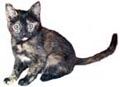
Feline Play Aggression
By Margaret Muns, DVM
Problems with aggression between cats, or between cats
and humans, are fairly common. However, most animals with an aggressive
behavior problem are not abnormal. In the majority of cases of feline
aggression, the cat is just displaying normal species-specific behaviors,
which becomes intolerable or even dangerous to humans in a household.
A complicated mixture of inheritance, learning,
physiology and early experience dictate whether or not a particular cat will
become aggressive. Complete knowledge of normal feline-specific behavior is
crucial in diagnosing the different types of feline aggression. For example, a
young kitten that hides behind corners and suddenly pounces with widely
dilated eyes is exhibiting normal play behavior.
Medical causes for aggression should be pursued only if a
cat exhibits behavior that is unusual for the particular cat, or behavior
accompanied by abnormal clinical signs. If a cat that previously loved to be
petted suddenly starts biting when stroked, you should look for a possible
source of pain.
Play Aggression
Play aggression is defined as the stalking, chasing,
pouncing, biting, and scratching behaviors, which normally occur when cats
engage in play. Problems occur when these behaviors are directed against
instead of with people in the household. These types of problems usually occur
in households with a single cat under two-years old. However, the problems can
also surface in homes where a younger cat is living with older cats that are
not playful.
Another common cause for play aggression towards humans
is when owners leave a single young cat alone for most of the day. Play
aggression can also be triggered and reinforced by owners who insist on
letting a cat "attack" their hands and feet.
Owners must learn to recognize the postures exhibited by
cats engaging in problematic, as opposed to acceptable, play aggression. The
typical play aggression cat will demonstrate predatory type of behaviors.
The cat will stalk the owners and pounce on moving body
parts such as hands and feet. Growling and hissing usually does not occur,
however, the cat's pupils will be widely dilated. Bites and scratches
inflicted during a play aggression attack are usually inhibited and not
severe.
In many cases of play aggression, the easiest solution is
to get another cat about the same age as the aggressive cat. Usually, a cat
engaging in play aggression will prefer to play with the cat instead of with
humans. The only risk in getting another cat is possibly adding territorial
aggression to the problem.
Cats usually do not accept a new cat into their house
without reaction. Introductions must be made slowly. You must also be willing
to accept responsibility for another pet and the added expense and needed
care. Personally, I prefer trying using behavior modification before
introducing a new pet.

Behavior Modification
You should make a concerted effort several times a day to
engage your cat in acceptable play behavior. All play behaviors must be
directed away from you or others in the household. Drag toys along the floor
by a string.
Be sure to place all toys with a string out of the cat's
reach when the animal is unsupervised. Eating string can cause a fatal
intestinal obstruction.
Throw ping-pong balls, or balls made out of crushed paper
or foil for the cat to chase. Leave paper bags and boxes out for the cat to
play in. Another trick is to tie a toy on to the end of a small fishing pole.
You can then "cast" the toy away from the cat’s body and
"reel" it in. You can also place bird feeders outside to entertain a
bored cat.
To discourage attacks, use a technique called
"remote punishment." You will first need to try to predict when
these playful attacks occur. As soon as you see the cat adopt a play
aggression posture, redirect the attack to a moving toy.
For this method to be effective, you need to get into the
habit of carrying favorite toys around with you. If needed, you can carry
water pistols or loud-noise objects. One effective noisemaker is an empty soda
can with some stones inside. Hand-held air horns are usually the most
effective. However, you might want to warn neighbors that you will be using
these noisemakers.
An alternative to loud noisemakers is for you to lunge at
the cat while stomping a foot, clapping loudly and hissing. Basically, you
want the cat to think that the "sky will fall" on them if they
attack you.
The timing of these remote punishments is critical.
Whenever your cat begins to initiate a play attack, you should use the
appropriate punishment. If you are consistent in applying the remote
punishment techniques, then the problem should be quickly solved.
Never use physical punishment to fix play aggression.
Grabbing your cat or hitting it on the nose or body will only make the cat
more aggressive. If physically punished, many cats can become defensively
aggressive.
Always avoid the temptation to let a cat "play
fight" with any part of your body. Doing so is a major cause of
inappropriate play aggression.

Is your kitty "Stressed Out"?
If so we have the answer: "Mellow
Out" Pet Relaxant
"Mellow Out" Pet Relaxant,
you can help your pet deal with the stress
associated with trips to the veterinarian or groomer or the stress of
being separated from you.
This amazing product eases tension without harmful side effects and
contains natural ingredients.
More Info
Online Here

Meow, Meow, Meow.....
By: Alfred
You all know I'm one good kitty and I absolutely love to be brushed!....
Every day!
And because I'm such a good kitty and do so many really useful things
around here....like guard the farm from rodent infestations, keep un-wanted
mice out of the house, hide all my toys so Dave has to constantly buy me more,
and make sure that big dog, Tippy, doesn't get out of line.
So without me, Dave wouldn't have a clue how to protect this place.
I'm the boss and I'm in charge, and actually, I
deserve the best
Hey, I'm worth it.
Here's my web site, and I want you to go there and get something really,
really special for your kitty today:
Check out Alfred's
Favorite Feline Cuisine Here
See Also:
Back to All Cat Care & Kitty Fun Stuff
Find More Really Cool Stuff about Pets: